

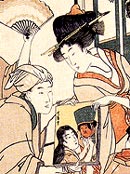

Torii Kiyomasa (鳥居清正)
|
 Torii Kiyomasa (鳥居清正 1776-1817) was a son and pupil of Torii Kiyonaga. He appears to have been active from the late 1780s through the early 1790s. Despite his obvious talent, he produced very few works. It may be that he was passed over as the heir to the Torii lineage when his father supported the succession of Torii Kiyomitsu's grandson Kiyomine (see Lane ref. below). Most of Kiyomasa's extant designs are bijinga (prints of beautiful women: 美人画), although a few yakusha-e are known (actor prints: 役者絵). By this time, yakusha-e were realistic (though stylized) portraits of male actors, whereas bijinga were idealized fantasies of the women being portrayed. Kiyomasa followed his father's style in these portrayals, but demonstrated convincing talent in doing so. Had he been able to continue developing his artistic vision, he might have achieved something more notable within the ukiyo-e tradition.
In 1788 and 1789, the actor-print specialist Katsukawa Shunkô introduced a series of at least 17 ôkubi-e ("large-head" pictures: 大首絵) in ôban format that set in motion the widespread production yakusha ôkubi-e by other artists, including Katsukawa Shun'ei, Katsukawa Shun'en, Tôshûsai Sharaku, Utagawa Toyokuni I, and Utagawa Kunimasa in the 1790s. The "large head" format also caught on within the genre of bijinga through designs by such artists as Kitagawa Utamaro, Chôbunsai Eishi, Eishôsai Chôki, and Torii Kiyomasa.
The public's fascination with certain reknowned beauties associated with Edo's teahouses resulted in a strong market for nishiki-e (full-color prints: 錦絵) portraying these alluring figures. Celebrity sold well, then as now. Kiyomasa's print depicts the popular waitress Okita 店先 (おきた) of the Naniwa-ya 難波屋 (なにはや) published by Tsuruya Kiemon (鶴屋喜右衛門 Senkakudô) around 1793. The Naniwa teahouse was located near the Zuijin Gate of the Asakasa Temple in Edo. Okita holds an uchiwa (non-folding fan: 團扇 or 団扇) decorated with her crest — a three-leaf kiri (paulownia: 桐). In keeping with the latest fashions, she wears an elaborate version of the shimada (島田) hairstyle (a type of chignon) called tôrôbin shimada (lantern-locks shimada: 灯籠鬢島田), characterized by flamboyant wings at the sides, which was in vogue in the late 18th century. Her robe is decorated with a restrained but sophisticated dye-resist kasuri (絣) or ikat pattern. © 2020 by John Fiorillo
BIBLIOGRAPHY
- Lane, Richard: Images from the Floating World: The Japanese Print. New York, 1978, pp. 135 and 286.
- Newland, A.R. (editor): The Hotei Encyclopedia of Japanese Woodblock Prints (Vol. 2). Amsterdam: Hotei Publishing, 2005, p. 496.
Viewing Japanese Prints |